
What it is
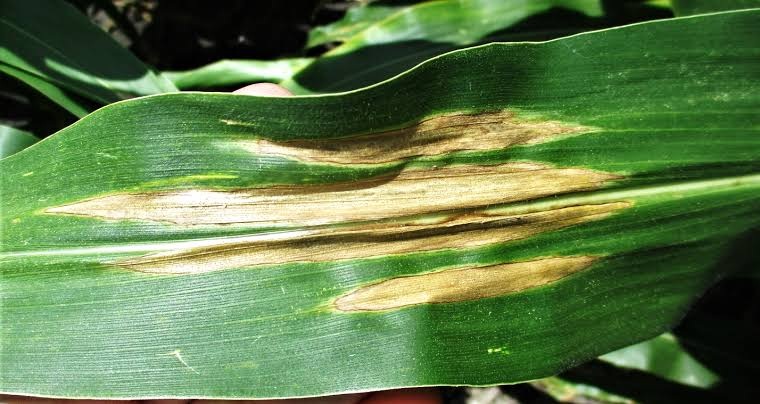
Northern leaf blight, also called turcicum leaf blight, is a serious maize foliar disease caused by Exserohilum turcicum. Its diagnostic sign is long, cigar-shaped or elliptical gray-green to tan lesions, roughly 3 to 15 cm long, that run parallel to the leaf and can merge to blight whole leaves. Mid-altitude tropical regions (about 900 to 1600 m) are especially favourable because dew periods are long and temperatures moderate. Yield losses of 30 to 50% are possible if the upper leaves are infected by silking.
Symptoms to look for
- Early lesions are narrow tan streaks running parallel to the leaf veins, with a water-soaked look
- Lesions expand into long cigar-shaped or elliptical gray-green to tan spots, about 3 to 15 cm long
- Mature lesions develop dark zones of sporulation, giving a dirty or sooty appearance in humid weather
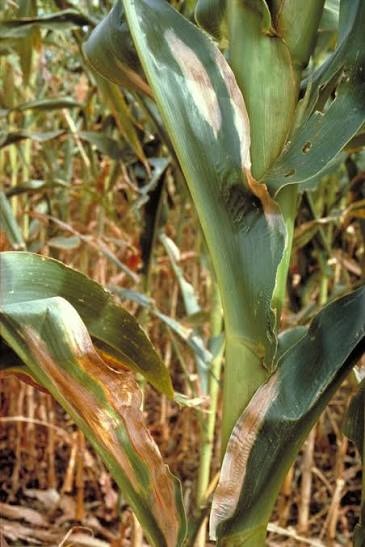
- Lower leaves affected first, with the disease moving up the canopy
- Severe infection blights whole leaves; plants can look frost-killed, and stalks may weaken and lodge
When it spreads
Moderate temperatures (about 18 to 27 degrees C) with prolonged leaf wetness - infection needs water on the leaf for 6 to 18 hours. Heavy dew, frequent rain, and high humidity drive it. Mid-altitude tropics (900 to 1600 m) are particularly favourable. The fungus overwinters on maize residue, so continuous maize and reduced tillage raise risk. Lesions appear 7 to 12 days after infection.
Treatment
Field practices
Plant resistant hybrids (partial resistance gives broad protection across races; race-specific Ht genes protect against particular races), rotate away from maize, destroy or plough under old maize residue, avoid continuous maize, use good spacing for airflow, and scout from the lower canopy before tasseling.
Organic options
Resistant hybrids are the most effective and preferred control. Combine with crop rotation and destruction or burial of old maize residue to cut the spore source. Copper fungicides and Trichoderma- or Bacillus-based biofungicides give limited preventive protection only.
Active ingredients
- copper hydroxide
- Trichoderma harzianum
- Bacillus subtilis
Chemical options
Foliar fungicides can be applied when lesions are first found, ideally before or around tasseling, and are most worthwhile on susceptible hybrids under high disease pressure. Effective actives include strobilurins (azoxystrobin, pyraclostrobin) and triazoles (propiconazole, tebuconazole), often as premixes. Alternate modes of action to slow resistance.
Active ingredients
- azoxystrobin
- pyraclostrobin
- propiconazole
- tebuconazole
Safety
Maize grain and green cobs are eaten, so follow the label pre-harvest interval before harvest. Wear gloves, a mask, and eye protection when spraying tall maize since spray can drift back. Keep children and animals away from treated fields until dry, and store products safely out of reach.
Preventing it next season
Planting resistant hybrids is the single most effective step, backed by crop rotation and residue destruction. Avoid continuous maize, use good spacing, and scout lower leaves before tasseling - the critical window is protecting the upper leaves through silking and early grain fill.