
What it is
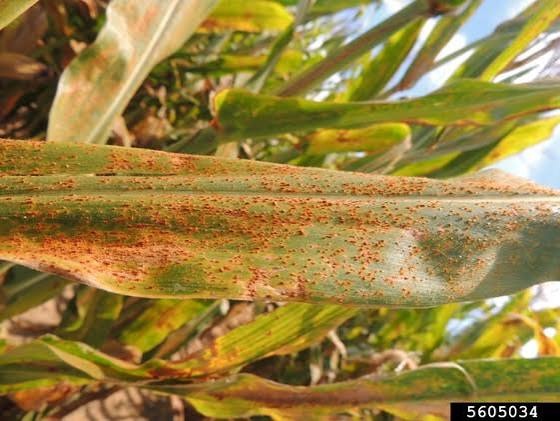
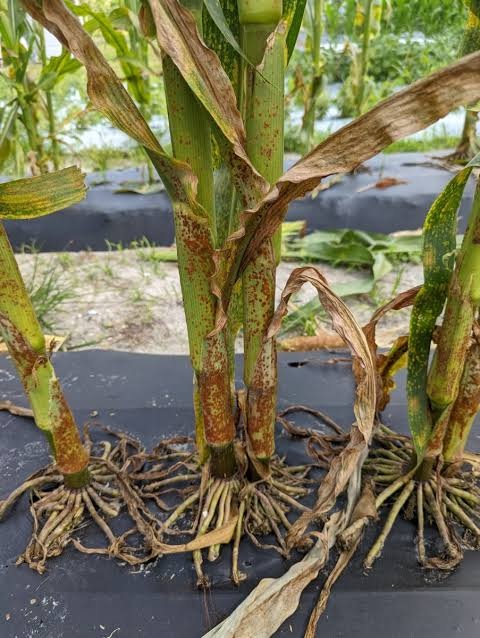
Common rust of maize is caused by the fungus Puccinia sorghi. It produces golden-brown to cinnamon-brown powdery pustules, scattered on both the upper and lower leaf surfaces, that darken to brown-black as spores mature. It is usually a minor disease of field maize but can reduce yield when severe, especially on sweet corn and late-planted crops. In warm tropical and lower-altitude areas, the related southern rust (Puccinia polysora) is often more damaging and can be confused with it.
Symptoms to look for
- Small, powdery pustules on both leaf surfaces, golden-brown to cinnamon-brown
- Pustules erupt through the leaf and release rusty (brick-red) spores
- Pustules darken to brown-black as they and the plant mature
- Symptoms usually appear after tasseling/silking, on mid to upper leaves
- Severe infection blights leaves, reducing photosynthesis and grain fill
When it spreads
Mild, moist conditions (about 16 to 23 degrees C) with high humidity, heavy dew, and long leaf wetness. Spores are windborne and can travel long distances. Late plantings, dense stands, and overlapping crops raise risk. Southern rust (P. polysora) is favoured by higher temperatures, so it dominates in hot, low-altitude tropical areas.
Treatment
Field practices
Grow resistant hybrids, plant early to avoid peak spore loads, control Oxalis weeds and volunteer maize, avoid overlapping plantings of different maturities, ensure good spacing and airflow, and remove or plough in crop debris after harvest.
Organic options
Common rust rarely needs spraying on field maize. Resistant hybrids are the main tool. Remove volunteer maize and control Oxalis (wood sorrel) weeds, an alternate host of P. sorghi. Copper or sulphur fungicides give only limited protection and are seldom worthwhile on field maize.
Active ingredients
- sulphur
- copper hydroxide
Chemical options
Fungicides are usually only justified on high-value sweet corn or seed crops, or when severe rust appears before grain fill on susceptible hybrids. Effective actives include triazoles (propiconazole, tebuconazole) and strobilurins (azoxystrobin, pyraclostrobin), applied early when few pustules are present. Alternate modes of action to slow resistance.
Active ingredients
- propiconazole
- tebuconazole
- azoxystrobin
- pyraclostrobin
Safety
If fungicides are used, wear gloves, a mask, and eye protection, and follow the label pre-harvest interval before harvest. Do not apply sulphur in very hot weather. Keep children and animals away from treated fields until dry, and store products safely out of reach.
Preventing it next season
Use resistant hybrids, plant early, control Oxalis weeds and volunteer maize, avoid staggered plantings, and provide good spacing and airflow. On field maize this is usually enough; save fungicides for high-value or severely threatened crops.