
What it is
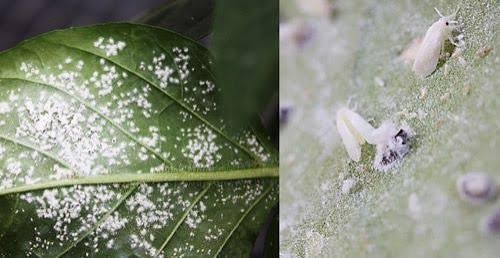
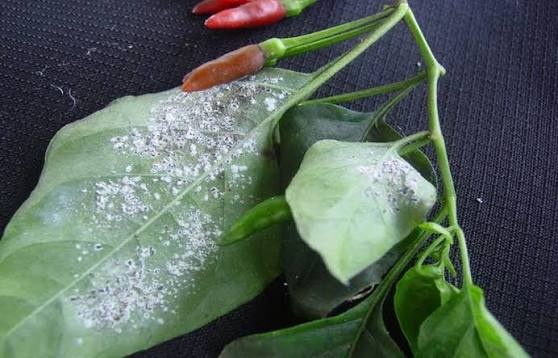
Whiteflies (Bemisia tabaci) are tiny (1 to 3 mm) sap-sucking insects that feed on the underside of leaves. They weaken plants by removing sap, excrete sticky honeydew that grows black sooty mould, and - most seriously - transmit many plant viruses, including the begomovirus that causes pepper leaf curl. Heavy infestations cause yellowing, leaf drop, and reduced yield.
Symptoms to look for
- Clouds of tiny white insects flying up when plants are disturbed
- Tiny white insects and immature scales on the underside of leaves
- Sticky honeydew on leaves, with black sooty mould growing on it
- Yellowing, chlorotic spots, leaf drop, and reduced plant vigour
- Virus symptoms (leaf curl, yellowing, distortion) where whiteflies spread viruses
When it spreads
Warm weather, common in tropical and subtropical areas and in greenhouses, with continuous host crops and nearby weeds. Whiteflies build up fast (a generation in about three weeks) and are worse from mid to late season. Broad-spectrum insecticides that kill their natural enemies can trigger worse outbreaks.
Treatment
Field practices
Raise seedlings under fine netting, control weeds and volunteers that host whiteflies, avoid planting next to heavily infested crops, remove and destroy heavily infested leaves or plants, keep a crop-free break, and monitor with yellow sticky traps to act early.
Organic options
Spray insecticidal soap or neem oil thoroughly on leaf undersides, repeating every 5 to 7 days for several rounds. Use yellow sticky traps to monitor and reduce adults, reflective mulch to repel them, and fine netting over seedbeds. Encourage natural enemies (parasitic wasps, predatory mites); a strong water spray knocks down adults.
Active ingredients
- neem oil (azadirachtin)
- insecticidal soap
Chemical options
Use insect growth regulators such as pyriproxyfen or buprofezin against eggs and nymphs, or spiromesifen, and neonicotinoids (imidacloprid, thiamethoxam) at transplanting to protect young plants. Whiteflies resist many products, so rotate chemical groups and avoid repeated use of the same class.
Active ingredients
- pyriproxyfen
- buprofezin
- spiromesifen
- imidacloprid
- thiamethoxam
Safety
Neonicotinoids and some other whitefly products are toxic to bees - do not spray flowering plants and apply in the evening. Wear gloves, a mask, and eye protection when spraying, follow the label pre-harvest interval, and keep children and animals away from treated plants until dry.
Preventing it next season
Use clean transplants raised under netting, monitor with sticky traps from early on, keep weeds and volunteers down, avoid overusing broad-spectrum insecticides that kill whitefly predators, and act while populations are low. This also reduces whitefly-spread viruses like pepper leaf curl.